The Worst Day of My Life
— and Why It Gave Me Permission to Write Again

Why does something bad have to happen for me to do what I already know I want to do?
If you’re part of the film business, you know the summer of 2023 was brutal.
The dual strikes shut everything down, writers, actors, and crews. Thousands of people suspended in uncertainty, waiting for permission to return to work, if “return” was even possible anymore.
We were living in Honolulu with our two teenage daughters. My husband, Eric, was producing and directing NCIS: Hawaiʻi. The show was thriving up to this point. Hawaii was an extraordinary place to live. Because we were so far from the mainland, the cast and crew became a set family.
The lead, Vanessa Lachey, was generous and deeply kind. It felt like a dream scenario, one we could all sense slipping away.
As the strike dragged on, it became clear that restoration as we knew it wasn’t coming. The stress settled into everything. And when people are under prolonged stress, they don’t always change all at once. They shift in small, easy-to-miss ways.
Eric started acting… off.
He would fall asleep the moment he sat down. He’d wander into the pool and jump in without warning, like someone stepping off a cliff in an old movie. He’d leave the house and not come back for hours, without any destination in mind.
But he was also still HIM.
When the Maui fires devastated Lahaina, he organized massive relief containers that actually made it through the perimeter. When a crew member died, he put together a memorial in hours, something that would take most people weeks.
“It’s the stress,” I kept telling myself.
By September, five months into the strike, I was angry. Furious, actually. I made promises to myself: I will never again build a life where our livelihood depends entirely on other people’s decisions.
Around the same time, our older daughter needed wrist surgery. What was supposed to be minor turned into a much larger excision. I was constantly calling the doctors.
Is this pain normal?
We got the bandage wet, what now?
When can she swim again?
One afternoon, I was put on hold.
It was Stroke Awareness Month. While I waited, a recorded voice listed the warning signs of stroke.
By September 20th, I was exhausted.
That afternoon, I found Eric lying in a hammock in our backyard, staring out at the ocean. He looked peaceful. I took a photo. I didn’t know how much longer we’d live in Hawaii, with that view, with that version of our life.
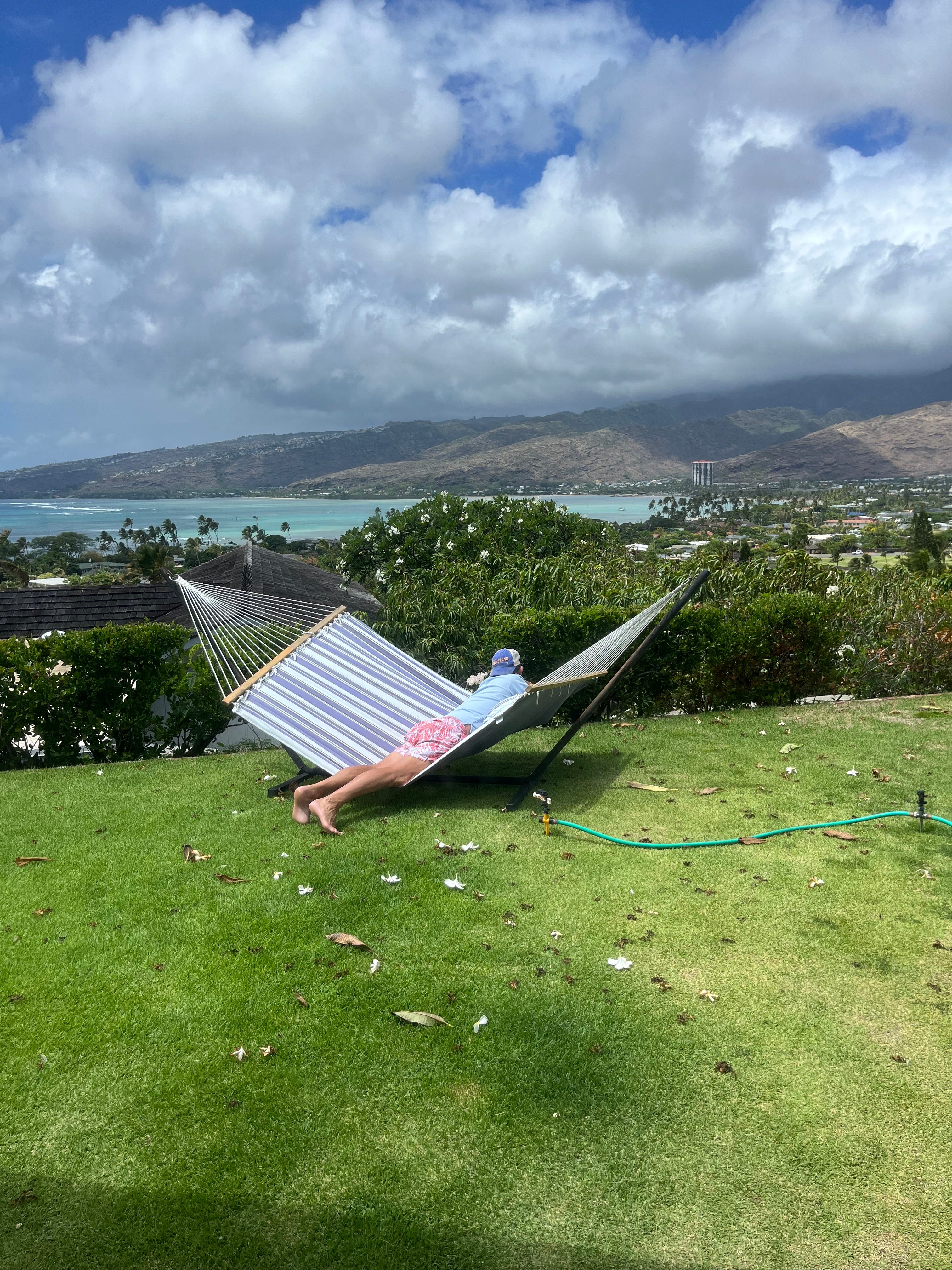
A few hours later, Eric stumbled through the kitchen holding his head in agony. I was making a pot of red beans and rice and told him I’d be in with Advil right away.
A few minutes later, I walked into the bedroom and froze.
He was lying in the middle of the bed, drenched in sweat. Perspiration literally dripped off his biceps as he mumbled, his words incoherent.
“Honey,” I asked, “what are you saying?”
Nonsense.
What were those stroke questions I’d just heard on hold?
“Eric, what day is it?”
“2002.”
“Where are you?”
“Arizona.”
“What room are you in?”
“Set.”
Tin Cup. A film set in Arizona.
“Oh my God. Call 911,” I yelled at no one in particular.
The next few hours were a blur.
The Hawaii Kai firefighters stood around our bedroom, asking if he’d taken drugs.
“No.”
They asked if he would normally know the date and time.
“Yes!” I answered vehemently. “He runs a 250-person film crew. High stress. High stakes. Totally on it all the time.”
As I followed the ambulance to the hospital, my sister called. She told me she had a vision of Eric wearing one of his signature Hawaiian shirts, smiling.
“When this is over,” she said, “he’s going to love this story.”
In the emergency room, the surgeon handed me a document to sign.
“We have hours,” he said, “before he dies if we don’t stop the bleeding.”
A subdural hematoma.
Eric kept asking how long the surgery would take and if he could go to Taco Bell first.
Miraculously, he made it through.
The next day, I sat in the hospital room watching him recover, a massive scar running along the side of his shaved head. Fifty-two staples held his skull together.
And my mind raced.
Where do we go from here?
What will his future look like?
He’s been the primary earner for years.
What am I going to do to help?
Am I ever going to write my book?
Is it even possible to monetize my writing skills?
If I don’t do this now, when will I?
What else has to happen for me to move forward in something that has value, something outside my family but still benefits them?
I took out my phone and made a note.
It was September 21st. I dated it November 1st.
It was a letter to my publisher.
Hi Jessica. I’m ready. Here’s the manuscript. Let’s get started.
The book wasn’t quite finished yet. But I knew it would be.
Miraculously, Eric came home four days later. No long-term side effects. By November, he was back on the NCIS: Hawaiʻi set when the strike ended. Today, he’s in Park City, Utah, living his best life on another huge production.
I’m back home in New Orleans with our younger daughter. Our older daughter has graduated high school and is thriving in college in Boston. Our family is spread out but very much together too.
So much has changed since that day in the hospital.
I’ve published my book. I’ve built a system to help women write theirs. I host a writing group that meets on Fridays. I’m even building a software platform to help female entrepreneurs share their stories.
And most importantly, I no longer wait for disaster to give me permission to move my life forward.
I would never want my husband to go through something like that again. But I’m grateful I listened to what the moment demanded of me.
Invitation: If you want to write the book that will build your brand, my new Skool group is live! You can join it here.
Wonderful